Governance & Mission Leadership Training | Half-Day, Full-Day & Custom Workshops
The People Responsible for the Vision
Deserve Tools That Match the Weight of It.
Focused workshops for governing boards, executive leadership teams, and mission-holders ready to move away from governance patterns that aren't working, build structures that actually carry the mission, and do the inner work that leadership at this level requires.
Three Tracks, Three Dimensions of the Same Problem
Whether you sit on a governing board, hold an executive seat, or carry the sustainability mission of your organization — the invitation is the same: to step out of governance patterns that cause harm, build structures that make the mission real, and develop the inner capacity that this kind of leadership demands.
Board Track
For: Governing boards, board chairs, board-ED pairs
The Work: Consent-based decisions, role clarity, meeting structure that moves, board-staff boundary setting
Starting point: Half-day or Full-day training
Senior Leadership Track
For: Executive Directors, CEOs or other Senior Leadership
The Work: Alignment on vision and strategy, distributed leadership, decision making, organizational culture
Starting point: Half-day or Full-day Leadership Session
Sustainability Officer Track
For: Chief Sustainability Officers, sustainability directors, those embedding mission into organizational systems
The work: Governance structures that carry sustainability strategy, aligning executive and board around long-term mission
Starting point: Tailored session: reach out first.
Three Movements. One Kind of Work
Gandhi described social change not as a single act but as three concurrent practices: stop participating in what causes harm, begin building the alternative alongside it, and tend to your own growth as the person doing the work.
This framework maps directly onto organizational governance — and it's the orientation that runs through all of our work.
Stop doing harm
Most dysfunctional governance wasn't designed to fail. It accumulated — through good intentions, inherited structures, deferred decisions, and the natural tendency of organizations to avoid conflict until it erupts.
The first movement is honest recognition: where are the patterns that are causing harm — to people, to mission, to the organization's capacity to function? This isn't blame. It's seeing clearly.
In these workshops, this looks like: naming what isn't working without pathologizing the people involved. Identifying which inherited governance patterns no longer serve. Beginning to step out of meeting cultures, decision processes, and role arrangements that drain rather than generate.
Start the parallel work
You don't wait for the old structures to collapse before building new ones. You begin now, alongside what exists — designing and implementing governance that actually carries the mission.
This is constructive, not reactive. It's not about what's broken; it's about what you're building that's better.
In these workshops, this looks like: developing consent-based decision-making practices that can run alongside existing processes. Clarifying roles and authorities so people can act without constantly seeking permission. Creating meeting structures that produce real outcomes.
Deepen the Inner Practice
The quality of governance is ultimately shaped by the quality of the people practicing it — their capacity to stay present under pressure, to hold complexity without collapsing it into false certainty, to remain in relationship with people they disagree with.
This isn't soft. It's structural and disciplined. How leaders listen, how they handle objection, how they make space for multiple perspectives including dissent — these are governance behaviors, and they can be developed.
In practice, this looks like: examining your own patterns in decision-making, relationships to power, and conflict. Developing the facilitation presence to hold a room without controlling it. Building the reflective capacity that keeps governance from hardening into bureaucracy.
These three movements aren't a sequence. They run concurrently — and each track below addresses all three, through the specific lens of your role and your organization's moment.
A Map of the Territory
Before naming what's possible, it helps to see clearly what's present. These tables are offered as a recognition tool — not a diagnosis. If several items in a column land, that's useful information.

For Boards and Governing Bodies
Patterns worth noticing | What those patterns can cost over time |
|---|---|
Discussions that circle without landing on a decision | Staff and leadership time drained by unproductive governance |
A few voices dominating; others quietly disengaged | Decisions delayed until they become crises |
Decisions made — then revisited at the next meeting | Donor and stakeholder trust quietly eroding |
Board roles that overlap, gap, or go quietly unfulfilled | Good people — board and staff — leaving |
The Executive Director filling governance vacuums that belong to the board | ED burnout from carrying what the board should hold |
Conflicts avoided until they erupt | The work that matters going undone |
For C-Suite Leaders and Other Mission-Holders
Patterns worth noticing | What those patterns can cost over time |
|---|---|
Executive team alignment that frays under pressure | Leadership capacity spent managing misalignment instead of advancing mission |
Decisions escalated upward that should live closer to the work | Initiative fatigue — good ideas that don't land |
Strategic priorities that don't survive contact with daily operations | ESG and sustainability commitments that lack internal governance to back them |
Sustainability commitments that exist on paper but not in practice | Staff confusion about who owns what and what actually matters |
A CSO or mission lead whose authority doesn't match their responsibility | Erosion of organizational credibility — internally and externally |
Culture and values that are aspirational but not structural | Succession gaps when mission is held by people, not systems |
Recognizing a pattern is the beginning of changing it. Each track below is designed to help you do exactly that.

Building Governance Your Board Can Actually Work In.
Board Governance Training is a focused, facilitated session that gives your board the tools to step out of patterns that aren't serving the mission — and start practicing governance that does.
This isn't a lecture or another presentation. It's an active working session built around what's actually alive in your organization right now.
What We Cover:
- Recognizing inherited patterns: A clear-eyed look at how your current governance developed — without blame, and with enough honesty to see what's ready to change
- Consent-based decision-making: Decisions don't need everyone to love them — they need no one to have a serious objection. This shift alone changes meeting culture
- Roles, circles, and authority: Who owns what, how authority is distributed, how to close the gaps and overlaps that create confusion
- Meeting structure that moves: Agenda design, facilitation moves, how to handle objections without derailing
- Applied practice: An exercise using a real challenge your board is currently facing
What You Leave With:
Shared language for conversations that previously got stuck.
A working model for consent-based decision-making your board can use immediately.
Clarity on roles, authorities, and decision ownership.
At least one meeting structure to implement right away.
A written summary: observations, recommendations, suggested next steps.
A candid picture of where deeper governance work could help: with no pressure.

The Vision You Hold Needs Structures That Can Hold It Back.
Executive and senior leadership teams carry the strategic direction of an organization — but the internal structures around how that direction gets held, shared, and acted upon are often underdeveloped relative to the ambition of the mission.
This track is for CEOs, Executive Directors, Chief Officers, and senior leadership groups ready to build governance and decision-making structures that are genuinely equal to mission-driven work.
What We Cover:
- Decision rights and distribution: Who has authority to decide what — and how that clarity (or its absence) shapes your culture and your pace
- Alignment under pressure: How to maintain strategic coherence when priorities compete, urgency escalates, and the team is operating at capacity
- Distributed leadership: How to move from leadership concentrated in one or two people toward systems where authority lives where the work lives
- Organizational culture as a governance question: How the informal structures — who gets heard, how conflict is handled, what gets rewarded — are themselves governance
- Succession and mission continuity: How to ensure the vision of the organization outlasts any individual who currently carries it
- Board-executive alignment: For ED/CEO participants: how to work with your board so the boundary between governance and management is productive, not contested.
What You Leave With:
A shared map of where decision-making authority currently lives vs. where it could improve.
A review of your organizational structure and how leadership could engage in improvement.
Language and tools for surfacing misalignment before it becomes conflict.
A written summary with observations and recommended next steps.
Clarity on whether deeper implementation work would be valuable — and what that could look like.
Why I Work This Way
I've spent more than 30 years working alongside mission-driven organizations — as a facilitator, founder, systems designer, and organizational consultant. The thread that runs through all of it is the same three-part practice: learning to stop participating in patterns that cause harm, build better structures in their place, and do the inner work that makes both not just sustainable, but regenerative for everyone.
Most training fails not because the principles are wrong or the consultants don't have the right tools, but because it stays abstract — disconnected from the actual tensions, relationships, and decisions that are alive in the room. People leave with frameworks they can't yet apply, because no one helped them see where those frameworks meet their real situation.
For years, I've helped to found and improve organizations using many ideas popular in leadership and organizational development. I navigated decisions, worked through conflict, held roles, and watched the systems evolve under real conditions. That experience is where I learned that governance isn't primarily intellectual. It's a practice. And practices are learned by doing, not by being told.
The integration I bring — ecological systems thinking, organizational design, awareness practices, facilitation, and governance — means I see governance as a living system, not a compliance structure. Unhealthy governance patterns can be recognized and changed, just as degraded land can be restored — through patient observation, discernment, deliberate intervention, and time.
- 20+ years working with mission-driven nonprofits, cooperatives, and purpose-led organizations
- 7 years as a participant (not a consultant) inside a sociocracy organization; 3+ years as E.D.
- Training and experience in sociocracy, consent-based governance, and organizational systems design
- Background in permaculture design and ecological systems thinking — applied to organizational health
- Facilitation of boards, executive teams, and multi-stakeholder groups across sectors
How to Get Started
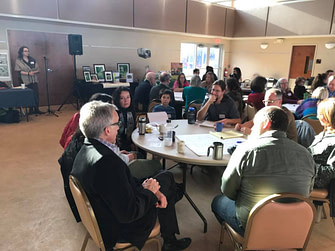
Choose your track (Board or Executive) and book a workshop or discovery call using the buttons below.
Brief intake conversation — 30-40 minutes — to understand your organization, your current situation, and what would make the session most useful. Every workshop is customized from here.
The workshop or session — facilitated on-site or virtually, followed by a written summary, recommendations, and a next-steps conversation.
Faq
Most governance or organizational development training teaches principles from the outside. This works from the inside — from your actual context, your current tensions, the decisions that are alive right now. Before any session, we have a real intake conversation so the workshop is built around what you're actually dealing with, not a generic curriculum.
No. The governance principles and facilitation approaches work across organizational types — nonprofits, cooperatives, social enterprises, purpose-led businesses, and organizations regardless of sector. What matters is that the people in the room are responsible for mission and long-term direction, not just operations.
Skepticism is healthy, and I don't ask anyone to buy in before they've experienced anything. The workshop is designed to meet people where they are — including people who are tired of frameworks that didn't stick. I offer tools. Your board decides what's useful.