- Home
- Author: Rhonda
This year, I did something I’ve thought about for years. I took a pilgrimage to my “home” on my birthday. I took the day off from obligations. I made my favorite birthday cake, celebrated with loved ones, loaded the seven-month-old bully pup into the car and set off with a fresh cup of coffee to wander the area I grew up in.
For years I told myself I would not drive past the house I grew up in after my mother sold the property. Too much pain and sadness. I wanted to remember the property full of life- trees we’d planted, flowers, fruits. But on the way, I had a change of heart. Holding the memory of the house as it was, also holds me in the past. So, I drove down the old highway and turned off on the country road I know so well. Driving past the woodlot and the old cow pasture, I remembered so many idle daydreams on the bus. I drove past neighboring houses…and then there was the house I grew up in.
It hasn’t changed as much as I thought or heard it had. And in the few moments of going past, I could feel myself letting go a little. Someone else lives there now. It is full of their dreams, their life, their moments. As it should be.
Driving the three miles to my real destination took me past other country neighborhood houses. I knew all the old stories, but things had changed. The horses were gone from the pasture and a tangle of willows grew in their space. Gardens were in places they hadn’t been before. Family-owned businesses were gone. But in many ways it was the same.
Muscatatuck Wildlife Refuge is about 7,700 acres of wooded wetlands, small ponds and lakes, and memories. When I was younger, there were so many small spaces outside on the two acres we called home that were a sanctuary and learning space to me—the cool grasses under the picnic table sheltered by arching ash trees. The divot under the giant wild rose bush where rabbits nested. The cluster of locust trees. The gardens. The old pond.
But the wildlife refuge was a place we went to almost as regularly as church each week. Mushrooms, fish, berries, nuts, persimmons. We gathered them throughout the year. We wandered on and off trail. I made friends with so many trees and observed so many animals. Going back this year after many years of not visiting, felt like renewing old friendships. These were my peers and friends as a child.
This was the place river otters were reintroduced to the state. Here is a heron friend. This is the place I wandered in thought around the curve of the trail and an eagle lifted off a stone a few feet away—the closest I’ve ever been to a wild eagle. These are the cedars I remember in a stand. Here is the seedless persimmon old Myers cultivated. This was the stand of blackberries we stood in the sun gathering for my father’s birthday cobbler. Here is the old sycamore bent in odd directions and now almost falling down.
Changes were evident as well—so many young forests that used to be fields. Young cedars now older. This is the landscape that inspired my drive to live more closely with the land and all the beings sharing space and time with me. This is the land that taught me the value of wetlands and all their beautiful, ever-changing, and unusual inhabitants. This is the land that gave peace to a challenged young heart.
It was an honor to revisit and rekindle that relationship. Returning to the place gave me perspective on all the ways it inspired me to become the person I am today. Perhaps this idea of refuge inspired me subconsciously to name my business the way I did. Refuge – Shelter – Peace. That is a lot of what I do in any context: I hold space for people to find inspiration, collaboration, and move toward action together. That is what I hope for the land-based projects I design: create spaces of relationship and abundance between people and the land they tend.
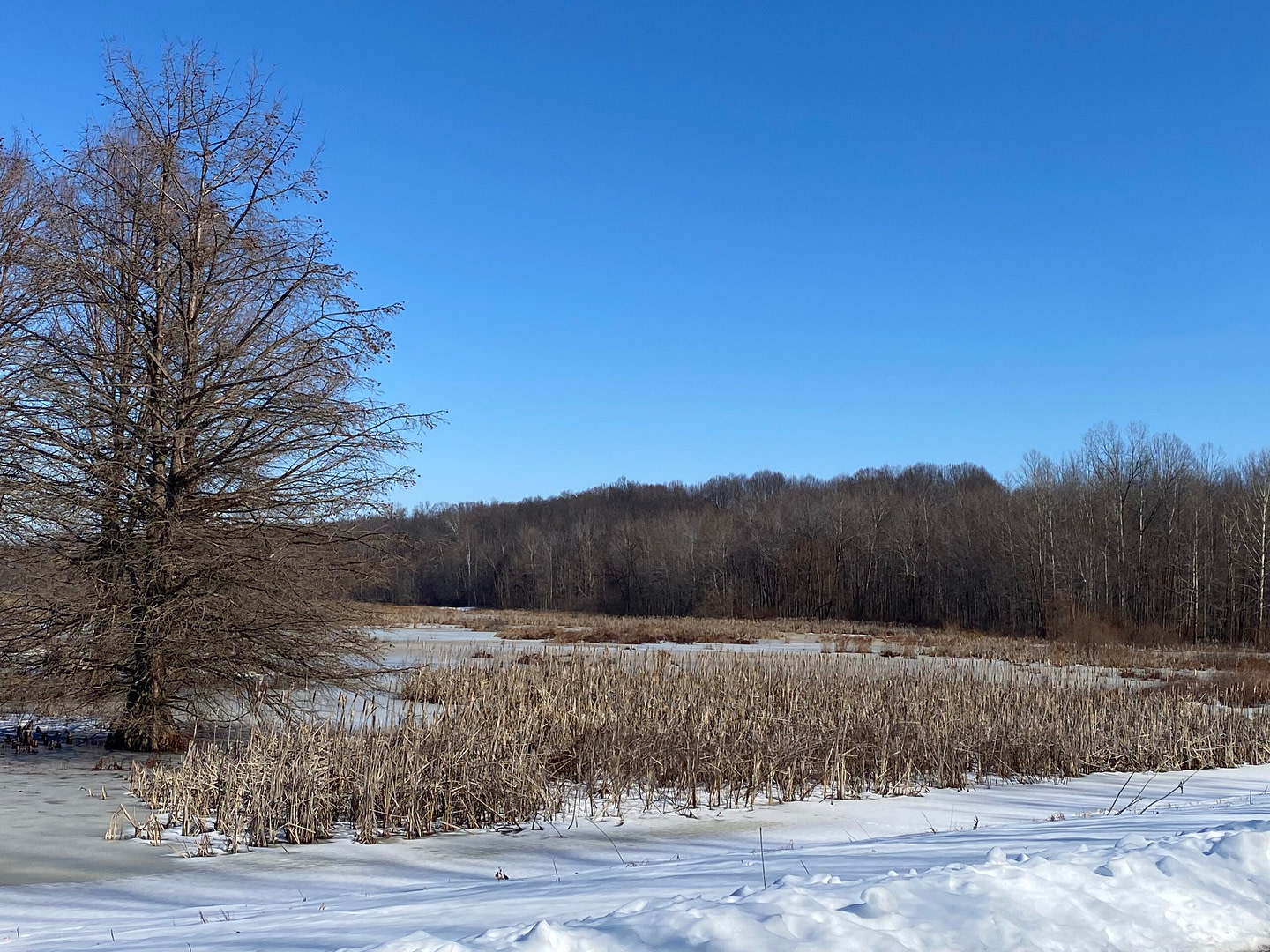
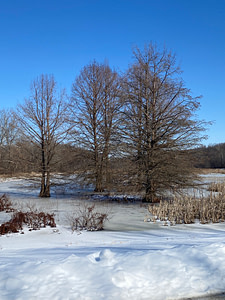
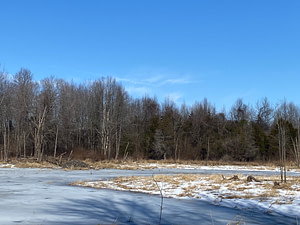
That day, I loved seeing the heron standing patiently. In the cold, almost of the water was frozen over. The beaver lodge was looking particularly cozy tucked on the back side of the pond. And in the blue, blue sky sandhill cranes were calling out to each other and heralding the beginning of spring. What a beginning to my own new year.
When COVID-19 reshaped our world in 2020, I found myself stepping back from the permaculture organizing and design work that had been central to my life. What began as a necessary pause became something more profound—a time of reflection, healing, and ultimately, transformation.
The decision to step away wasn't simple or singular. COVID created immediate practical barriers to the hands-on, community-centered work that permaculture thrives on. In the weeks before the shut-down, I had been slated to return to Belize to teach at MMRF, but had the intuition to cancel. (That's another story). If I'm honest, the pandemic also gave me permission to acknowledge something I'd been noticing for a while: patterns in permaculture spaces that didn't quite add up.
My own health and personal struggles during this period brought things into sharper focus. While I was learning to listen to my body's limits, to recognize rest as essential rather than optional, and to understand healing as its own kind of work, I was also noticing contradictions around me. People talking about "care of people" while running themselves into the ground or maintaining an extractive mindset. Abundance mindsets that seemed to mask deeper anxieties. Claims of sustainability from those whose personal practices and relationships seemed to contradict our ethics and principles.
I needed space to sort through what was working from what wasn't—both in the movement and in my own approach.

Stepping back from permaculture organizing didn't mean stepping back from learning. In fact, this period became unexpectedly rich with insight as I found myself deep in other work that would profoundly shape how I understood community, decision-making, and the transformative work of regenerative culture.
My role as executive director at Sociocracy for All opened up entirely new territory. Working with dynamic governance and sociocratic principles, I was learning how organizations actually function—not in theory, but in practice. I was seeing how groups make decisions, how power moves through groups, how consent differs from consensus, how structure can either support or undermine the people within it. This wasn't abstract organizational theory; it was daily problem-solving with real people navigating real tensions. The work we've done in the past two years is some of the most difficult any organization can undertake--and we've done amazingly well with it.
At the same time, my experience with Tracker School, its instructors, and elders was teaching me something complementary but different. There was a directness there, a groundedness in immediate awareness and personal responsibility that cut through a lot of the conceptual layers I'd been working with. The tracking mentality—reading what's actually there, following what's real, trusting direct observation over assumption—became a lens I couldn't unsee. The healing and caretaking work learned there, and at the related school, Wilderness Fusion, invited me to work on healing "my Earth" -- my body, mind, and spirit.
These two streams of experience started converging with what I'd learned in permaculture. I could see the patterns more clearly now: how permaculture principles weren't just about land design but about any living system, including teams and organizations. How the observation skills I'd learned tracking applied to group dynamics. (I had already been vocalizing how the inner and outer landscapes merge in our design work; but this took on new depth.) How the governance structures we were implementing at Sociocracy for All addressed some of the exact dysfunctions I'd witnessed in permaculture spaces.
I began to understand that my years in permaculture had given me frameworks for understanding systems, relationships, and change itself—but these other experiences were showing me how those frameworks applied to the human systems I'd struggled with. The principles of observation, of working with rather than against, of seeing connections and patterns—these worked just as well for understanding organizations and group dynamics as they did for understanding ecosystems.
But the most important realization came slowly, through all of these experiences together: personal health, well-being, and growth aren't separate from permaculture—they are fundamental to it.
This wasn't abstract. It was intensely practical. I couldn't design sustainable systems if I couldn't maintain my own energy. I couldn't teach regenerative practices while depleting myself. I couldn't facilitate healthy team dynamics or community processes while ignoring my own need for rest and renewal. And I was seeing, again and again across different contexts, that the same was true for everyone else. If teachers, organizers, or designers do not address the internal patterns they carry; they will recreate systems that harm the Earth, people, and the future.
Permaculture principles apply to the practitioner, not just the practice. Dynamic governance only works when the people using it are functioning well. Tracking skills require a tracker who's present and grounded. Care of people includes caring for yourself. It has to, or nothing else lasts.
I'm returning to permaculture now, but I'm returning with a different toolkit and a broader perspective. My experience with dynamic governance has given me practical frameworks for how groups can actually function well together—how to structure decision-making, how to clarify roles and responsibilities, how to create feedback loops that work. The tracking mindset has sharpened my ability to read what's actually happening rather than what I think should be happening. And my work with teams at Sociocracy for All has shown me that sustainable community isn't accidental—it requires intentional structure and honest assessment.

I'm more committed than ever to fostering permaculture community, but grounded in something I see now as essential: walking the talk. And I now have clearer ideas about what that actually looks like in practice.
By this, I don't mean perfection. I mean being willing to look honestly at what's working and what isn't—in our own lives first, then in our communities. It means building practices that are actually sustainable, not just in theory but in lived reality. It means closing the gap between what we teach and how we live. It means applying the same observation and feedback principles to our human systems that we apply to our land systems.
Self-responsibility is central to this. In permaculture, we design for meeting our own needs, for managing our outputs, for understanding our impact. That same approach extends to our personal well-being, our patterns, our capacity, and what we need to function well. We can't build healthy communities while ignoring our own health. We can't create regenerative systems while running ourselves down. This isn't just permaculture wisdom—it's what I learned watching organizations struggle or thrive, what I learned from tracking instructors who modeled groundedness, what I learned from facilitating governance processes that only worked when people were actually resourced enough to participate.
And perhaps most importantly, I want to help build a permaculture movement that genuinely considers future generations—not just in what we leave behind, but in how we model living. Future generations need more than good soil and clean water. They need examples of people who learned to pace themselves, who built sustainable personal practices, who created communities with clear structure and real accountability, who were honest about what worked and what didn't.
If you're reading this and feeling the resonance of these questions, know that you're not alone. Maybe you've also noticed the gap between permaculture's promise and some of its practices. Maybe you've also struggled with balancing taking care of systems with taking care of yourself. Maybe you've also wondered how to build something truly sustainable when even well-intentioned communities sometimes lack the structure and processes to support that sustainability.
I believe permaculture's principles and practices are robust enough to address these questions. I believe the movement is mature enough now to look honestly at where things haven't been working, to learn from what we've tried, to adjust our approach with the same attention we give to our gardens. And I believe we can draw on insights from other fields—including dynamic governance and organizational development—to strengthen how we work together.
The work I'm most interested in now is helping create spaces where personal well-being and permaculture practice are understood as interconnected. Where we can talk about what's working and what needs adjustment. Where we have clear structures for making decisions and navigating conflict. Where self-responsibility isn't just about managing our waste streams but about managing ourselves. Where we apply the same observation skills to our teams and communities that we apply to our ecosystems.

This is my invitation: to anyone who sees permaculture not just as techniques but as a practical framework for living well on this earth, and who's willing to bring other tools and perspectives to the work. Let's build this together—starting from where we actually are, building from what actually works, learning from multiple disciplines and the lived experience we've gained wandering in our own lives.
The pause taught me that sometimes the most productive thing we can do is stop, rest, heal, and return when we're ready—bringing with us everything we've learned from that time, including what we learned elsewhere.
I'm ready now. And I'm grateful for what the stepping back taught me about stepping forward—and for the unexpected teachers and experiences that filled that time.
The search for better ways to organize ourselves while living in harmony with the Earth has led to many innovative approaches. Two particularly powerful frameworks—permaculture design and dynamic governance (also known as sociocracy)—share remarkable synergies that, when combined, create robust systems for both ecological and social sustainability. Both are rooted in systems thinking and offer complementary tools for creating resilient communities. In this post, I'll be using "dynamic governance" and "sociocracy" interchangeably.
Permaculture and sociocracy both emerged from a deep understanding of how natural systems function. Permaculture was developed by Bill Mollison and David Holmgren in the 1970s. Permaculture Design applies the patterns and relationships found in natural ecosystems, traditional human (horti-)cultures, and scientific thinking about systems to human settlements. Similarly, sociocracy (refined by Gerard Endenburg from Kees Boeke's earlier work) draws inspiration from cybernetics and systems theory to create self-organizing governance structures.
Both approaches recognize that:
Permaculture is guided by three core ethics: Earth Care, People Care, and Future Care. While Earth Care focuses on ecological sustainability, the other two ethics provide a foundation for social organization that aligns perfectly with sociocratic principles.
The People Care ethic recognizes that human wellbeing is essential for truly sustainable systems. This ethic calls for meeting basic needs, fostering connection, and creating inclusive communities. Sociocracy offers practical methods to manifest these values through:


Permaculture's third ethic (sometimes called "Return of Surplus" or "Fair Share") focuses on limits to consumption and equitable distribution of resources. Sociocracy's governance approach directly supports this by:
Permaculture groups often face challenges in maintaining long-term collaboration and preventing burnout. At the North American Permaculture Convergence, I noted to a colleague, that we have the technical or design knowledge to solve many of the ecological aspects of climate change, but we lack the capacity to create projects (schools, farms, communities) that can maintain the regenerative work over the coming generations. Projects fail, for various reasons all the time. This led me to search for better methods of governance--and ultimately to Sociocracy for All.
Implementing dynamic governance methods in permaculture projects can help by:
Many permaculture initiatives struggle with unclear decision-making methods. Sociocracy provides a structured approach that honors both individual voices and collective needs. By implementing consent-based decisions, groups can move forward efficiently while ensuring everyone's critical concerns are addressed.
Rather than relying on charismatic founders (a common permaculture pattern), sociocracy distributes leadership throughout the organization. This prevents burnout of key individuals and creates more resilient organizations that can thrive beyond their founders.
Permaculture emphasizes observation and response to natural systems. Sociocracy extends this to human systems through regular evaluation processes. Implementation reviews, role improvement feedback, and circle effectiveness assessments create the same kind of responsive adaptation that permaculture seeks in ecological design.
Permaculture groups often aim to create support networks for mutual aid. Dynamic governance structures can formalize these networks into effective helping systems without becoming bureaucratic. For example, care circles can be established with clear domains and authorities while maintaining the flexibility to respond to emerging needs.
Consider a community food forest project. Using permaculture principles, the physical design might include diverse plant guilds, water management systems, and strategic placement of elements for maximum efficiency.
Adding dynamic governance might look like:
This integration allows the community to maintain both the ecological system and the social system needed to care for it long-term. Further, my experience with participants learning dynamic governance, shows that there is a lot more trust, more effective collaboration, and greater movement towards our vision and mission.


The partnership between permaculture and dynamic governance offers a powerful approach to creating systems that care for both the Earth and its people. By combining permaculture's ecological wisdom with sociocracy's governance structures, communities can build organizations as resilient as the landscapes they tend.
The next evolution in regenerative design may well be this integration of ecological and social technologies—creating systems where humans thrive as beneficial participants in the web of life, organized in ways that honor each person's voice while serving the whole.
I'll be continuing this line of thinking in future posts.
This quote seems more applicable today than ever before:
― Bill Mollison
In the 20 years since my own permaculture design course, I am reminded again and again to return to the basics of permaculture design. It’s the “chop wood, carry water” kind of simplicity that I find comforting.
Permaculture offers a holistic approach to thriving and living that extends far beyond gardening. At its core are three foundational ethics that guide all permaculture practices: Care for the Earth, Care for People, and Care for the Future (often called “Fair Share” or “Return of Surplus”). Within this ethical framework, there are some key practices.
The first ethic recognizes our responsibility to protect and nurture natural ecosystems. This ethic is first because without it, we cannot meet any of the other needs.
Healthy soil is the foundation of all permaculture systems. This involves:
Biodiversity creates resilient ecosystems that resist pests and disease:
Water-wise practices include:
The second ethic focuses on meeting human needs sustainably and equitably.
Human habitation can be designed to work with nature. Most likely we will be adapting existing structures. Whenever possible, we want to be:
Access to healthy food and clean water is a fundamental human right:
Strong communities are resilient communities:
The third ethic acknowledges our responsibility to future generations and the equitable distribution of resources.
Creating systems where “waste” becomes a resource:
Moving beyond fossil fuels:
Safeguarding biological and cultural heritage:
What makes permaculture unique is how these practices are woven together through thoughtful design. Permaculture design principles—like obtaining a yield, using and valuing diversity, and catching and storing energy—provide the framework for implementing these ethics in practical ways.
The most effective permaculture systems address all three ethics simultaneously. For example, a well-designed food forest cares for the earth by building soil and creating habitat, cares for people by providing nutritious food and medicine, and cares for the future by sequestering carbon, cleaning water, and preserving biodiversity.
By centering these three ethics in our design decisions, permaculture offers a pathway toward truly sustainable and regenerative living that benefits all life on Earth—now and for generations to come.
So, at the end of the day, I look at what I have accomplished. Is the soil a little better today? Is there capacity to hold water appropriately in the landscape? Did I see a new species or old friends? Did I harvest something from the garden? Have I interacted with my loved ones in a positive way? Have I done something to help my community or helped those who help others in their communities?
The solutions really are simple.
This post appeared originally in Permaculture Design magazine, issue #112 as "Mistakes We Make."
Everything and everyone is my teacher. This was made explicit in my Standard Class at the Tracker School, though I had been using it implicitly for much of my life. I’ve learned from others mistakes, but I’ve learned the most from my own errors. And I’ve made more mistakes than I can recount. You probably could say the same. What mistakes have you learned the most from?
What is a mistake?
A mistake is an action or judgement which is misguided or wrong. Our mainstream culture and the constant attacks and criticisms on social media can make us cautious about claiming something is wrong—or it can encourage us to make a claim about something being misguided or wrong without really offering our reasoning and actively thinking about the matter.
Call me odd, but as a mid-Westerner, I wonder about the erosion of common sense. When Thomas Payne wrote “Common Sense” he was creating a common vision or understanding of what should be considered normal and right.
When I look at the synonyms for “mistake,” I see that many of them are based on feedback. Ahh! There we go with systems thinking. In our permaculture understanding, we might begin to actively welcome feedback and sharing our learning with others. I imagine this is how many of our smaller communities mentor each other into creating a common-sense approach to making a living in the past.
Errors, miscalculations, and omissions
When we make an error, we do not get the results we were looking for. A miscalculation will mean lower yields or no yields in the garden. Too little fertility in the soil and the harvest is poor. Too much water for too long, and the perennials will drown. If we choose the wrong species in our forest garden, disease or drought or flood or temperatures can lay waste to our investment.
I miscalculated how quickly ground cover would re-grow after I pastured my chickens in our 1/8 acre of back yard. The ground was heavily shaded by a 55-year-old silver maple. I moved the chickens and relatively bare ground was seeded (I thought). It would regrow. Nature is abundant, right? It turns out that it not really true. There is a limiting factor in terms of light and growing time (the chickens were particularly damaging in the early spring, late fall, and over winter). My four hens needed more land to cover, and the land needed more light to foster re-growth.
If I were to bring poultry into the space now, I would do two things: 1) limb up the silver maple, and 2) work with quail instead of chickens. It turns out the quail are showing up without my introducing them. I just need to find their nest. I learned there are limits in any situation, and I could have had less damage to my system if I had taken action on the feedback sooner.
One very common mistake I warn my design students about is spacing. We are very optimistic about how many plants we can fit in our landscapes. I made this mistake, and I was gratified to hear Toby Hemenway admit to the same experience years ago in an online forum. Paula Westmoreland, of Ecological Design in Minnesota shared some of her experience for this article:
“One of the mistakes I made early on in broad-acre design was making an alley width too narrow in an alley cropping system. Space was limited in one of the fields I was designing and I was trying to stack as many crops as I could into the field so I designed 15’ wide alleys for the hazelnuts and elderberries. This worked fine in the early years when the shrubs were small. The alleys could be mowed, animal tractors moved through them, or they could be planted with another crop. But as they matured the alley became unusable space. It was too narrow to easily move equipment through and not enough sunlight to harvest another productive crop. The lesson that hit home to me was I needed to do my due diligence and design what the system would look like and how it would be managed through the full lifecycle of each of the anticipated crops.”
Some of systems may give feedback over very long timeframes. My 65 year old home has a basement that was dug by hand AFTER the house was built. In 65 years, it had never flooded until February of this year. Oops. Because of that, there had never been a sump pump installed. Now, we are faced with removing all of the flooring and drywall to install a perimeter drain, a sump pump, and sealing the walls.
Building mistakes can be very expensive. I know of a permaculture person who built a very large building with the first floor laid in cement block. There was a subtle (2”) curve in one of the walls when the block was laid. This meant that each truss for the second floor had to be custom measured and built for the exact position. Tedious.
A design client of mine brought me into work with them after their house was under construction. It turns out their dream home is built 10’ below a seep. There is no way to channel the water in a different direction due to the building choices they made. They live with a sump pump running constantly—actually they have a timer to turn it off at night so they can sleep. That is a Type 1 error—something that will exist as long as people live in that structure on that site. These are all examples of miscalculations. Sometimes however, a mistake is made due to a misunderstanding.
When we feel competent to begin our work with design clients, we make a lot of mistakes. Since we’re working with someone else’s dollars, time, and property, mistakes can be really scary. Understanding our clients is really important. One of my early clients was a couple on the verge of retirement. I laid out a design, but I didn’t do a thorough analysis on elevation (as we all agreed based on observation what was needed). It turns out we were off. The placement of the plants in the design didn’t change (because the relation to the sun was the same), but the direction of the beds to run across contour did. It was a minor mistake, but a very obvious one. I learned to always do a thorough analysis—which became easier with the publication of GIS sites with better data over the next year.
This same client also taught me about timelines. Most clients want and need a long timeline for implementation, but these were able to implement the design I thought would take them three years within the first year of their retirement. Good health, means, commitment, and skills served them well. Listening to the client helps us match up goals and capacity. Jude Hobbs of Cascadia Permaculture shared this story:
“One of the very earliest lessons I learned when I started my Landscape Design Business was not listening deeply to a client. I worked with a retired couple who were so excited about doing a whole systems design for their property…they wanted to include most everything I enjoyed bringing to a design. They loved the idea of edibles for humans and wildlife, water features, area for composting by the garden, aromatic plants, fall color, minimal lawn….you get the idea. We worked together on the design and they were thrilled with the result. About 6 months later I called them to see how the installation went—they said; “We loved your design but realized a lot of it would not work for us, come by and see what we have done.” To say the least, I was surprised when I arrived and saw lots of lawn and concrete where a multitude of plants were to have been. When asked what happened..they said they realized they were going to be traveling a lot and also did not want to spend the amount of time it would take to maintain the gardens. Since then I always utilize a questionnaire which includes the crucial question..how much time do you have to maintain your landscape?
As you can tell, 35 years later I remember the incident well and am mindful in the awareness of deep listening. Also, it’s not about pleasing the designer but focusing on clients’ needs and realistic goals.”
Misguided, misunderstood, misinterpreted
When we began our forest garden, I was determined not to prune our apples and plums. I was influenced by my reading of Masanobu Fukuoka’s non-interference principle. This fit with the STUN method I’d heard of from Mark Shepard—Sheer Total Utter Neglect. That seemed to fit with the lifestyle of a 30-year-old mother and organizer who was taking up a permaculture teaching and design lifestyle while also trying to homeschool and implement some significant home economic projects.
One apple grew tremendously each spring for three years—reaching 15’ very quickly. I was so very excited about 16 ounce apples, until a windstorm knocked it over. I realized the roots had not been growing at the same rate as the rest of the tree. Likewise, the plums were thick with foliage and covered with blossoms—but by not pruning—there was insufficient air flow. Black knot, a common fungus, took hold, and I ended up losing both plum trees.
Gaffe, faux pas, misconception
When it comes to society and cultures, there are many, many mistakes to learn from. Some of them are mine. Some of them are not. I’ve judged the book by its cover—I’ve made assumptions about people based on their age, skin tone, dress. I’ve been the book judged by its cover—people have considered my light skin tone, midwestern mien, and education an indication of a very particular (and misconceived) background. I try very hard to not be limited by this kind of thinking and to connect more deeply with people I encounter.
On a different level, I’ve invested years of my life and time I didn’t have into projects which did not provide the yields I was looking for when I invested initially. About five years ago, there was a complete board changeover with a 25 year old sustainability nonprofit in my community. I proposed to them that I put in the organizing effort to convert it to a local permaculture institute—and they agreed. However, new board members elected at the time of my proposal and working closely with established projects didn’t fully buy in to the new vision. After three years of service on the non-profit board, I refocused on the regional permaculture institute, Great Rivers and Lakes Permaculture Institute. It was taking too much effort to try to re-pattern the local project.
Mistakes come in varying degrees
Some mistakes are not very costly—in terms of time, materials, and energy. Some mistakes cost dearly. I’ve got an experiment going in my kitchen now with kombucha. For the cost of counter space for a week, a bag of sugar, a few tea bags, the energy to boil the sugar water, and the kindness of a friend, we will see how it goes. I hope it’s not a mistake, but it’s not very costly to me either way.
The client with the home built below the seep has a very costly mistake to pay for if the trends toward more severe rain events continue in our area. Someone else I know continued to build out their design without permits. This resulted in a lawsuit and ultimately the sale of the property. In the process, a slew of relationships were upended. That was very costly, indeed.
We might consider the failure of people to participate in legislative process and the utter failure of policy to make meaningful change in our society as a mistake of epic proportions. Likewise, the failure to address social unrest and cultural bias—while overwhelming—is something we all have to live with. Because we all have to live with these mistakes, it is important that we engage with them collectively.
Mistakes are an opportunity for iterative design
When the apple and plum trees came down, I had the opportunity to plant peach and sour cherry trees that suit my region better. I knew that because it took a few years of the permaculture community—and some permaculture nurseries in particular—to experiment and find out. It turns out pie is one of my favorite desserts, so why not peaches and cherries?
I worked with a client recently who wanted everything written in experiment form. All of the plantings would be trials. I believe this is very clever. He will be inclined to observe and track the performance of his investment. Further, he already knows there will be feedback in the form of failures. By tracking the implementation closely, he can determine the source of the mistake. That learning can be valuable for our region.
What if there are no mistakes?
Recovering from a mistake can help us to transform experience into wisdom. At a point in our lives, we want to support those who are learning the skills we’ve mastered so that they do not make the same mistakes we did. That mentoring is one of the beautiful things about community and extended family or tribe. The re-skilling of Transition Towns, the farm schools and sewing courses and gardening time with the neighbor down the street are all ways to re-establish the common sense of an adaptive future.
While mistakes can be costly, they can also provide us with resource and opportunity that we couldn’t imagine without going down that path. We have a choice about how we approach design and implementation. We can not do anything—a very safe way to control the situation. We can do something and succeed. We can do something, fail and learn from it.
When we consider the incredible pressures and failures as our culture and ecosystems run up against limiting factors, there’s no time NOT to be making mistakes.
In Search of our Ancestors’ Gardens
Breeding Plants for the Gardens to Come
(Originally published in Permaculture Design magazine, issue #105, 2017)
I remember exploring my grandfather’s gardens. Bryce Ping had five gardens located in different parts of the Jackson County, Indiana: each one sporting some of the same—but often different varieties—of squash, corn, peppers, and tomatoes. The garden on his own property was one of the finest examples of integrated systems I’ve ever seen—replete with beds on contour, re-use of water, rabbits, geese, and chickens. Everything was mulched with newspaper and grass, sawdust, or spoilt hay from nearby. He lived on the salvage economy: heating with scraps from the sawmill and re-using every plastic container that entered his house.
He is also the one that introduced me to the varieties and unusual qualities of many fruits, flowers, and vegetables. His entryways were lined with canned goods (his own parents had tried to run a canning business when commercial grocery stores came into their region) and he continued to value preserved food—often experimenting with recipes. Jars also held seed saved from year to year. Paper plates were often found in the kitchen in summer—drying various seeds from the day’s harvest. He wasn’t very meticulous about labeling them—but I imagine now he must have developed several of his own varieties. When he passed, my aunts distributed the goods—and I wonder what happened to those canned goods and seeds. It would have been a fortune in genetic diversity.
His story reminds me of one relayed to me one night over dinner in Naperville. Peter Bane and I were teaching a permaculture design course at The Resiliency Institute in Naperville, Illinois, when Ron and Vicki Nowicki came to dinner. I still haven’t made it to their garden—which by all accounts is a feat of implementation. Vicky shared the story of a tomato variety she grows out in her garden. The seed was, like many seeds in the US a hundred years ago, brought into the country by immigrants. The seeds were so important, the relationship over generations so strong, that many immigrants would sew the seeds into the linings of their clothing. The tomato she spoke of had been grown by a second generation Italian man for, if I remember right, 60 years, before passing it on to her. He inherited it from his grandfather and parents, but his own children did not care to garden. So she has taken up the relationship.

Perspective from the stars
If we consider that flowering plants evolved shortly after conifers roughly 300,000 million years ago, the development of hundreds of thousands of species today in the vast array of colors, shapes, scents, and behaviors is truly astounding. If we take it that humans have been around for 6 million years, plants embody natural wisdom a great deal more. Still, the 200,000 years of human civilization might be defined by the relationship of people to plants—mutually cultivating each other (see Michael Pollan’s Botany of Desire for more on that thought). Our leap into agriculture 10,000 years ago is only a fraction of that time and represents a rift in thinking: moving from relationships to plants in community (polycultures) towards primary relationships with a few key domesticated species (wheat, corn, barley, squashes, etc…). This relationship of people to plants—especially cultivation of food plants—is one which we must re-enter: humbly and quickly. If you asked me the top five skills children should be learning, seed saving and plant breeding would be right among them. Food—and seeds—are also one of the very best tools to reconnect, not only with the land, but with our ancestors. (Okay, so I’m not SO keen on the leek favored by my Welsh ancestors, but it has its place).
Everybody loves popcorn
While beginning to relearn the culture of my Native American (primarily Cherokee/Ani'yunwiya) forebears, I came across a story of “The Lucky Hunter” and his wife, Selu—a Corn woman (1). In order to feed her children, Selu would give of herself. That is the place of corn in importance—it is literally the mother of some of the earliest people in the land. The same reverence for plants which sustain and nourish us is found throughout the world. When I think of the awe which my grandfather instilled in me for flowers, fruits, and tastes which were varied and full of wonder; which resonated with the relationships of people to plants throughout history—I want THAT WORLD again for the next generation and all generations going forward. I firmly believe we will not survive as a species if we do not cultivate that respect and connection to plants and their children (seeds).
It must have taken some similar connection for people to facilitate the evolution of teosinte into maize. Teosinte, a multi-stem grass found throughout Central America with 5-12 small, hard seeds was domesticated into modern maize and corn varieties. The story might be that earlier people used teosinte as fuel in the fire and found that the kernels popped—everybody loves popcorn! Indeed, some of the oldest archeological records include popcorn. (2) Research now recognizes that the development likely focused on only a few characteristics initially—severely limiting genetic diversity. (3) Once favorable characteristics made the plant more desirable as a cultivated food source, other genetic variations —leading to more than 20,000 landraces (locally adapted varieties)—were bred into maize through local selection. This diversity probably reflected a combination of factors for selection including: migration, settlement, and local ecological diversity. Breeding plants has to consider the size of the population in any one area. Inbreeding among a variety can become a problem. Read Zachary Paige’s article for more on how corn was kept from inbreeding too much.
In the 1920’s, modern agronomists began breeding hybrids selecting for uniform yellow kernels, size, etc…. Today, the close kernel size and the tight hold of the cob to the kernel means that without intervention from farmers, most corn kernels would not be able to germinate and reproduce on their own. Truly, we are in a tight relationship of mutual dependence with this wonderfully diverse species. Our futures are linked.

Plant Breeding Today
Just this spring the USDA granted $17.7 million dollars to study plant breeding: all to universities—most to public land-grant universities (8). The grants were in the areas of foundational knowledge of production systems; plant breeding for agricultural production; and physiology of agricultural plants. Besides hybridization and cross-breeding, another technique: precision breeding—has become an option today. This technique works with genetic sequencing from embryos of the plant varieties without introducing foreign or new genetic material—and it gives results in one or two years instead of four or five. (4). This technique is more appealing to European plant breeders who are cautious about genetically modified organisms with cross-species introductions of genetic material.
Who’s Who?
We are familiar with the idea that a lot of agronomy research comes from land grant universities throughout the United States. But there are other major players to be found. The Gulf Coast Research and Education Center, which has brought us commercial tomato and strawberry varieties as well as working on developing pomegranates that can tolerate the Florida summer and so replace citrus. (5). Seed companies themselves breed out varieties of plants that are successful or in demand (think Johnny’s Seed Company). Then of course there is Seed Savers Exchange—and now the many seed libraries found in communities everywhere. We are very familiar with plant breeding and patents on commercial seed. South Africa released its catalog of licenses recently and most commercial crops were licensed to US-based Pioneer and Monsanto companies (9). Other countries that do not have national laws recognizing plant patents are pressured to develop them as quickly as possible.
A new option has been developed in Germany: licensing seed research as open-source. “Anyone can use the varieties, so long as they do not prevent others from conducting research on derivatives; all of the plant's future descendants are also in a ‘commons.’ ” (10) The article continues to describe a similar project in the US—the Open Source Seed Initiative (OSSI) which concluded in 2014 that it was “too unwieldy to gain widespread acceptance among breeders and seed companies…”. This is because intellectual property rights play a bigger role in plant breeding in the US—indeed patenting initiated in the US in 1930. “Commercial breeders, the main producers of economically important new crop varieties, can't use open-source seeds because they would not be able to claim royalties for any varieties they develop from them. If too many seeds were in the open source–only commons, they would be "killing the business model,” Neils Louwaars of Plantum in the Netherlands says. Many universities would also lose out if they could no longer charge royalties for plant traits or breeding tools.”
Still, thinking back to Vicki Nowicki’s story, many plants we have today were bred a hundred or more years ago and continue to produce (and sometimes cross). Luther Burbank, a contemporary and friend with Henry Ford and Thomas Edison, working in the late 19th and early 20th centuries developed more than 800 new varieties of plants—“including over 200 varieties of fruits, many vegetables, nuts and grains, and hundreds of ornamental flowers.” (6). His gardens and programs are continued on today in Santa Rosa, California. Indeed, it was his efforts which inspired the annual Rose Parade.
Breeding and Selection in Permanent Agriculture
Breeding plants and patenting the seed’s genetics are well-known strategies for privatizing (and maintaining the option to get a yield on, if you will pardon the pun) researched food crops. Open source seeds, seed libraries, and commercial seed sources that maintain open-pollinated and heirloom seeds are some of our unsung heroes for food production. Researching this article has highlighted for me again the need for all of us to take up some small part of the work. There are so many benefits: saving money by saving seed; developing varieties that suit your system—whether that’s being productive under greater extremes, fitting a particular microclimate, or introducing new flavor or color into a species. So, how do you do it?
Creating a permanent agriculture can start from different theoretical points—but they all go back to breeding and selecting plants. We cannot create a permaculture system without knowing how to select and breed plants in our own communities. Not every person has to be a seed saver or nursery person, but we should all know at least one. J. Russell Smith, in his well-known treatise Tree Crops: A Permanent Agriculture, made the work of John Hershey, a Depression era nurseryman in Downington, Pennsylvania famous. Hershey grafted and developed various oaks: including his famous bur oaks (see issue #102), for their vigor and early production of acorns. [Editor’s note: since the publication of that article, a small group has begun taking scion wood and continuing to improve the oaks through breeding and selection. If you would like to get involved, contact us.] Similar trials for hazelnuts are now famous at Badgersett (see Eric Toensmeier’s contribution, this issue).
The Land Institute is also well-known for its efforts begun by Wes Jackson in 1983 to create perennial wheat as a way to prevent soil disruption. The Institute has expanded its understanding and framing of its research and is seeking, through plant breeding, to develop several perennial grain crops. Kernza (R) is the closest to commercial implementation. This wheat variant is just now coming onto the market after more than a decade of development. While seeds are smaller (1/5 the size of most commercial wheat varieties), there are more seeds per stalk. The breeding program is selecting for “yield, shatter resistance, free threshing ability, seed size, and grain quality.” (7). Programs to develop sunflowers and sorghum are also well underway. With sunflowers (silphium) the motivation goes beyond choosing a grain or oil crop that can become perennial in the landscape, to considerations for drought tolerance and climate change as well as ecological functions with pollinators. The group started with wild sunflowers that showed remarkable resilience during drought in the Plains states.

Whether we are looking to use improved selections for local small-scale gardens or for broad-scale and regional production to local markets, it is important that we consider our capacity to take up plant breeding. Even if you rent or coordinate a garden plot in an urban setting—you have the space and capacity to grow out seed. The new insights provided by Gregor Mendel and others into genetics stimulated the creativity of 19th century horticulturists like Luther Burbank. At a time of rapid change and variability in ecosystems, it might not be the minds and efforts of a few brilliant breeders, but the simple commitments and creativity of permaculturists everywhere working with nature that builds the bridge between the gardens of our ancestors and those of our descendants.
Whats and Hows
So, what are all of these plant breeders doing? They are, by nature, mostly savers of seed with an eye toward ensuring that particular plants reproduce seed in a relatively pure fashion. Seed saving is one of the most direct ways to cross and breed plants. In classic plant breeding, individuals that are particularly early, robust, tasty, or beautiful—or fill in any other trait—are allowed to set seed and that seed is carefully harvested, stored, and germinated to breed out the next generation. Any propagation technique can be involved (cuttings, layering, etc…): the operative function is that humans are selecting favored characteristics and cultivating a space to include those varieties. Mutations can arise in cuttings or individuals and perpetuate through cuttings, etc… It might behoove us to more carefully observe what is evolving in our forest gardens and using that as a start.
As with any breeding project, a variety can become inbred after a few generations—increasing the fullness of the desired traits, but also diminishing other qualities—including germination rates. It is important to renew genetic stocks by bringing in—or intentionally crossing—with other samples of the variety or another variety which is compatible and might improve fruiting, flavor, size, disease and pest resistance, etc…. Two in-bred lines that are crossed produce an F1 hybrid. The yields from these plants theoretically increase, but crosses between F1 hybrids (F2) can be wildly inconsistent in their production. It is a good idea to cross F1’s and F2’s back to the original stock or move back into very narrow selection in the breeding program.
When breeding your own vegetables and fruits (and sometimes shrub species, but not tree species very practically), you can control which plants pollinate a specimen by hand pollinating and bagging the flowers all the way through seed production, by isolating the variety from potential pollinators by distance, or by isolating the flowering in time from undesirable crosses. You can also weed out undesirable plants among a breeding population (called roguing).
When it comes to keeping records, it’s a good idea to not only label seeds carefully during storage, but also keep track of what is planted, when, and where; as well as notes on development, in a garden journal. If you keep a digital record, including photographs could be very helpful. Burbank was reportedly a horrible record-keeper; preferring to see results in the garden.
The Seed Hoarders’ Dilemma
I find myself with a problem which I bet will be familiar to some of you. I do not have an unlimited budget for commercial seeds; nor do I have much land to grow out uncertain seeds on for test plots. What I do instead is hoard seeds—including both commercial and home grown seeds. I now see this as a fear-based way to retain natural capital. Remember our third ethic: I could give away seeds or put them in the seed library to be borrowed, renewed, and returned to me at some point when I can use them well. What I need to do is continue to plant out the varieties in my seed storage and save the seeds from the plants I’ve grown: refreshing viable stocks and renewing genetics by offering seed and bringing in new seeds from seed exchanges and libraries.
All of this is to say that we can have a lot of fun practicing permaculture by breeding plants that marry our tastes and delights to the needs an functions of the gardens we inhabit. We can do that while feeding our families, sharing with our neighbors, and educating the uneducated. We can use our horticulture to build bridges with those who have a slightly different worldview (ever enter your prize pumpkin in the county fair?). Smart selections might also become valuable locally and spur on greater innovations through seed exchanges. Rather than passively perusing the nursery’s offerings, why not aim to create what you want—allowing the process to surprise, challenge, and delight you with discoveries?
This summer, my kitchen has begun to look like my grandfather’s. He would be so proud.
References and Resources
Caduto, Michael, J., and Joseph Bruchac. Keepers of Life: Discovering Plants through Native American Stories and Earth Activities for Children. Golden, Colorado: Fulcrum, 1998.
Hartmann, Hudson T., Dale E. Kester, and Fred T. Davies, Jr., Plant Propagation: Principles and Practices. Englewood Cliffs, New Jersey: Regents/Prentice Hall, 1990.
Pollan, Michael. The Botany of Desire. New York: Random House, 2002.
Smith, J. Russell. Tree Crops, A Permanent Agriculture. Reprint. Atlanta, Georgia: Pathfinder Press, 2016.
1. http://sacred-texts.com/nam/cher/motc/index.htm, accessed May 1, 2017.
2. http://www.weedtowonder.org/domestication.html, accessed June 23, 2017.
3. http://www.pnas.org/content/106/Supplement_1/9979.full, accessed June 23, 2017.
4. https://thesheridanpress.com/visiting-research-hopes-to-uncork-expertise/, accessed June 3, 2017.
5. http://www.83degreesmedia.com/features/US-Agriculture-research-Florida-innovation-0617.aspx, accessed June 5, 2017.
6. https://www.lutherburbank.org, accessed June 28, 2017.
7. https://landinstitute.org/our-work/perennial-crops/kernza/, accessed June 28, 2017
8. http://www.growingproduce.com/vegetables/usda-gives-17-7m-in-grants-for-plant-breeding-production-studies/, accessed June 3, 2017.
9. http://www.gov.za/services/plant-production/plant-breeders-rights, accessed June 6, 2017.
10. http://www.sciencemag.org/news/2017/06/german-breeders-develop-open-source-plant-seeds, accessed June 22, 2017

This beautiful, fragile flower reminds me so much of squash blossoms. I am appreciating the delicate veins in the petals and the way it is folded and curled. But what is most lovely about the blossom is that this lily has kept on putting blooms out after (two weeks? three?) the other lilies stopped. It keeps reaching out to the sun.
I find that hopeful and beautiful.
How do you keep reaching for the sun and sharing your glorious nature?
There are hundreds of definitions of permaculture. Here's the one I use: Permaculture is an ethical system of design that integrates humans with the natural world.
Let's break that down.
Permaculture = "permanent agriculture" and "permanent culture"
Ethical = Care of the Earth (primary); Care of People; Care of the Future
System = working with an awareness of the interconnectedness of elements of any system we focus on.
of Design = We are co-creating with the Earth and with other people in a way that is intentional and careful
Integrates Humans with the Natural World = we developed a civilization/society that has disconnected us from the Earth we depend upon. (This one if full of tricky implications if you think about it.) Further, we tend to be deeply disconnected from each other.
We can do better, and we can keep improving.
I begin almost all of my permaculture design courses with the question:
What is going on in the world? What's the news?
It doesn't take long for the board to fill with "events" that, when we look at them, are systematically connected. Just as the problems are interconnected, so are the solutions.
It is time to reintegrate our way of life so that we can heal the Earth, heal ourselves, and tend to the best possible future. We can return to a life which is deeply connected--one that allows us to express the best of the human journey on the planet. What can that look like?
Most of all, this is about limiting our impact on the Earth and tipping the balance toward a way of life that will allow future generations to thrive. We can imagine, design, and enact that right now.
One of the challenges, as we have gone online is that our social evolution is on the surface. I interact with people from around the world on an almost daily basis via zoom. While the interactions with people are spread out, they are also shallower. Our mission-driven interactions allow for some connection and understanding, but there isn’t often time to build deeper connections and cultural practices which really nurture relationships and networks. In a world of 15-second Tiktok videos, how do you develop connection to a shared vision?
Our ecological and social systems are beyond the limits and collapse is underway. Collapse has been affecting people; destroying and destabilizing whole sections of population for most of my adult life. What we are talking about now is the level of acceleration. Extractive behavior continues—putting financial and social capital in the hands of the privileged. People are both distracted by social media and other entertainment and utilizing an online context to reorganize their lives and connections so that power and resources can be distributed more fairly to meet the needs of the Earth and people. Neither focusing on negative realities and despair nor toxic positivity and denial is helpful. The pandemic has given us all a moment to wake up and re-evaluate what is critically important—as well as to see the delicate situations we are in.
So, what are we to do?
Who is the “we” in that question? Permaculture people, readers of this article, family members, activists, and members of organizations. Community members. Business owners. Staff or employees. In each role, or context, we have the capacity to work from principle and pattern toward common vision. Those contexts need relatively stable boundaries. A consequence of our globally connected world—and especially the past the wealth of the past 30 years in the US and other affluent countries—is that people have been able to move where they like far from family and friends. That has been positive in many ways but limited our direct experience of community around us as well. We are lonelier and suffering more mental health issues than ever before. (Hence, projects like the Human Library.)
One of the challenges and wonders of our current world is that it is so very accessible. By nature, we define ourselves and our lives by the people with whom we have regular contact. Those are the people we are invested in. As permaculture people, we want to design systems that improve our quality of life and the lives of those we connect with. In terms of changing the world, when we put intention and choice into our systems, it can send a positive ripple out through the whole—and when many of us do this, it can rapidly change the nature of our world in a positive way. So, who is your “we”? Who do you want to design with? Who do you share a vision or mission or dream with?
Many times, we don’t get to choose everyone in our groups and collaborations. Friends of friends show up, or people respond to a call to action. A variety of perspectives are introduced. Each person has some valuable experience or question to bring to the conversation. Once we know who we are co-creating a future with—allowing for shifts and changes as life demands—we can then find the common threads and themes of our vision.
Once we know who “we” are and what we are working for, we define both the limitations and problems we need to solve, and the immediate and long-term aims implied in our vision. In 2016, at the North American Permaculture Convergence in California, I was sitting in one of many delightful, long conversations with Bonita Ford. It became clear in the conversation that we have an endless supply of good technical and design solutions to our ecological problems. However, projects fall apart over lack of ability to sustain them (financially and energetically) and old, internalized patterns of oppression and communication which feed conflict and foster differences. People leave relationships or projects and move on to something new. In a world with many options, that is perhaps for the better. But in a world of increasing constraints, moving on may not be as much of an option. (I have spoken of this concern several times in articles Permaculture Design.) In this case, we need more careful and skillful design of our social worlds to creatively respond to the moments we are in. Once our personal and social lives are more in balance, our built structures and ecological worlds are more likely to reflect this health. I’ve spoken elsewhere about personal balance and design for self-care. In the next post, I want to focus on social design and, specifically, about how sociocracy blends with permaculture in a positive way to create strong containers for our collective vision.
This post is an excerpt from the Spring 2022 issue of Permaculture Design magazine, which Rhonda edits. You can find out more about effective governance from visiting Sociocracy For All.
Page 1 of 8