
Lessons from the ancient world and the labor movement for regenerative culture
In the first post in this series, I wrote that permaculture and sociocracy are off-ramps — essential exits from a destructive highway, but not the destination itself. I ended with a question: if these frameworks help us exit, what does the road ahead actually look like? And how do cultures build new roads in the first place?
My own search for answers took me into historical studies — specifically into the ancient world, where I could watch cultural transformation unfold across centuries and begin to see the underlying patterns. I also studied American history to see how this change looks in the modern world. What I found there has shaped everything about how I understand our work today.
The pattern that emerges, across vastly different contexts and centuries, is both humbling and clarifying. People adopt cultural practices and beliefs that help them survive. These solutions give them hope. Not what is most philosophically elegant. Not what is most ideologically pure. What actually helps them keep their families fed, their communities intact — and what gives meaning to why they’re doing it at all.
There’s a second part to the pattern that matters just as much: people don’t adopt new solutions wholesale. They weave them into what they already know. The new and the existing evolve together into something neither tradition could have predicted alone. When movements try to prevent that weaving, they often enforce rigid orthodoxy. They demand that people abandon their existing ways of understanding the world. These movements almost always fail. They fragment or calcify into institutions that serve their own survival more than the people they were meant to help.
This is both sobering and the most hopeful thing I know for those of us working in regenerative culture.
What follows is a vast oversimplification, but I hope the story-telling here helps to make the larger points.
———
Early Christianity in Egypt
When Christianity arrived in Egypt in the first century CE — tradition holds that Mark the Evangelist brought it to Alexandria — it entered one of the most sophisticated spiritual cultures in the ancient world. Egypt had millennia of religious tradition, profound cosmology, and deep practices around death, the afterlife, and the sacred dimensions of the natural world. You might expect that a new religion would struggle to take hold in such a place. Instead, it took root with remarkable depth and became something distinctly, unmistakably Egyptian.
Why? In part because it met real needs at a moment of cultural stress. Roman imperial rule had destabilized Egyptian society. The early Christian communities offered something the empire did not: burial societies that guaranteed dignified interment regardless of wealth, mutual aid networks that cared for the sick, and community structures that held people through hardship. This was not abstract spiritual appeal. It was practical. It kept families alive and gave the dead their dignity. People adopted it because it worked.
But it also offered something harder to quantify: hope and meaning at a moment when the old structures of meaning were under pressure. The resurrection promise, the radical equality of souls, the sense that the suffering of the present moment was not the final word — these things resonated in a community living under occupation and facing the erosion of its ancient identity.
And crucially, Egyptian Christians did not simply replace their existing understanding with imported theology. The iconography of Isis nursing the infant Horus flowed almost seamlessly into images of Mary and the Christ child. The ancient Egyptian cross, the ankh — symbol of life — was absorbed into the Coptic cross. The desert monks who developed Christian monasticism were drawing on existing Egyptian traditions of solitary spiritual retreat. What emerged was Coptic Christianity: recognizably Christian, and irreducibly Egyptian. The Council of Chalcedon in 451 CE would try to enforce a single, standardized Christology across the empire. The Coptic Church refused. The attempt to impose doctrinal uniformity from above nearly destroyed the relationship between Alexandria and Rome — and the Coptic Church survived, and continues to this day, precisely because it remained rooted in its own cultural soil.
———
Buddhism and the Making of Ch’an
The story of Buddhism traveling the Silk Road into China offers an even more dramatic example of the same process.
Buddhism arrived in China roughly around the first century CE, but for several centuries it remained something of a foreign import — studied by scholars, practiced in monasteries, but not yet woven into the fabric of Chinese life. What changed was not missionary effort or imperial decree. What changed was that Buddhism found its meeting point with what China already knew.
In Central Asian communities along the trade routes, Buddhism had spread in part because the monasteries were rest stops — literal places of refuge for merchants and pilgrims crossing brutal terrain. They provided food, shelter, community, and a framework for understanding the suffering and uncertainty of trade-route life. The dharma offered a coherent account of impermanence that was not denial but a practical tool for living with it. This was useful. It met real needs. And so it traveled.
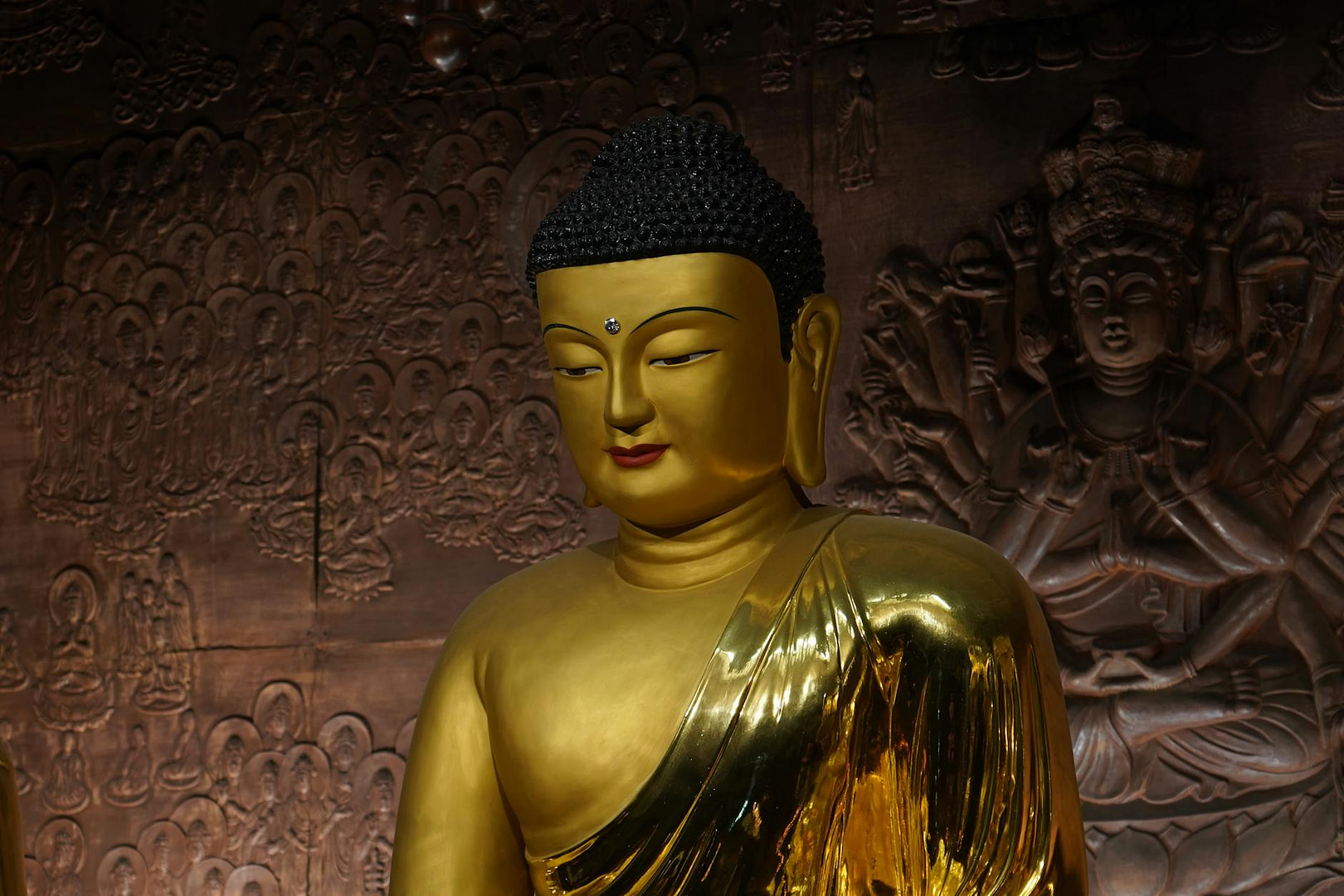
When Buddhism encountered Chinese Taoism and Confucianism, something remarkable happened. Chinese thinkers didn’t simply accept Indian Buddhist metaphysics. They asked: what does this mean in conversation with what we already understand about the natural world, about the ineffable Tao, about the importance of direct experience over textual authority? Over centuries, that dialogue produced Ch’an Buddhism — what the Japanese would later call Zen — which is perhaps the most thoroughgoing example of syncretism in religious history.
Ch’an took Buddhism’s meditative core and rewired it through Taoist sensibility. Where Indian Buddhism was often text-heavy and scholastic, Ch’an declared itself “a special transmission outside the scriptures.” The sudden enlightenment that comes not from accumulating doctrine but from direct encounter with reality — the famous koan, the master’s unexpected gesture — these were not in the original Indian package. They emerged from the encounter between Buddhist practice and the Taoist understanding of naturalness, spontaneity, and the limits of conceptual knowledge.
The Indian monks who first carried the dharma across the mountains would not have recognized it. That is precisely the point. Ch’an Buddhism is not a corruption of the original. It is what happened when profound wisdom met a living culture and both were transformed. It has endured for fifteen centuries because it is genuinely rooted, not merely transplanted.
———
What Mutual Aid History Teaches Us
The history of mutual aid in the United States tells the same story in a more recent register, and it is a history that has been systematically obscured.
From the mid-nineteenth century through the early twentieth, mutual aid societies were among the most vital institutions in American working-class life. Immigrant communities — German, Italian, Jewish, Polish, Chinese, Mexican — built elaborate networks of fraternal organizations, benevolent societies, and burial clubs that provided what the state did not: sickness benefits, death benefits, loans, childcare, legal help, community belonging. African American communities, excluded from white institutions by law and by violence, built parallel mutual aid networks of extraordinary sophistication — mutual aid was foundational to Black community survival from the era of slavery forward. Firefighters in urban centers also created some of the initial mutual aid groups leading to the idea of modern insurance programs.
These were not ideological projects, at least not primarily. People participated because the societies worked. When you were sick and couldn’t work, the society paid your rent. When your husband died, the community buried him and helped feed your children through the winter. Each immigrant group also brought its own cultural forms — its particular governance traditions, its existing sense of what mutual obligation meant — and wove those into the new structures. The ideology, where it existed, came after the practice.
The rise of the welfare state in the mid-twentieth century, whatever its genuine benefits, also crowded out this independent infrastructure. Insurance companies lobbied against mutual aid societies as competitors. The cultural story shifted: the state would care for you, or the market would. What communities had built for themselves began to seem unnecessary.
In each of these three examples, we could look at patterns of intense change and pressure. There is also incredible opportunity for exchange and dialogue among travelers, scholars, migrants, and merchants who are carrying ideas. I find it all fascinating and instructive.
What we’re watching now — in the solidarity economy movement, in food sovereignty networks, in the resurgence of mutual aid during the pandemic — is not something new. It is something very old reasserting itself because the conditions that made it necessary have returned. People are building buying clubs and tool libraries and childcare cooperatives and seed libraries not because they’ve been convinced of an ideology, but because these things work — and because they offer something the market increasingly cannot: genuine community, genuine belonging, genuine stake in each other’s survival.
This is the pattern. This is always the pattern.
———
What This Means for Our Work
Cultural change is slow. Genuinely, structurally slow — because culture is the accumulated solution set of a community. It doesn’t shift until the old solutions stop working, or until new ones demonstrably do better at meeting the needs people actually have: economic security, belonging, meaning, hope for their children.
The historical pattern also carries a warning that I think is particularly important for regenerative movements to hear. Every example I’ve studied — Coptic Christianity, Ch’an Buddhism, mutual aid societies, the cooperative movement — succeeded in part because it allowed for adaptation. It let people bring what they already knew. It did not demand that newcomers abandon their existing frameworks before they could participate. When movements have tried to enforce doctrinal purity — to insist on one correct permaculture practice, one right way to run a sociocracy circle, one authentic form of nature connection — they have tended to shrink rather than grow, to become communities of the already-converted rather than living cultures that spread because they genuinely help people.
This doesn’t mean anything goes, or that there are no core principles worth holding. It means we hold those principles with enough flexibility to let them take root in different soils. The permaculture practiced on a working farm in rural Kentucky will look different from what’s practiced at an urban food forest in Detroit, and both will look different from what develops in a community garden in Nairobi. That’s not drift. That’s the pattern working correctly.
The most important work we can do is not to convince anyone that our frameworks are philosophically correct. It’s to demonstrate — through working farms, through functional co-ops, through communities that survive conflict and come back stronger — that these approaches actually meet needs the dominant culture is failing to meet. To be what the Buddhist monasteries on the Silk Road were: places of genuine refuge and practical help, not monuments to an ideology.
And it means building from where we actually are, with the people who are actually here, meeting the needs that are actually pressing. Not the idealized future community, but this watershed, this struggling nonprofit board, this farmer watching her soil wash away and not knowing what else to try.
———
But there is one more condition for cultural change that history reveals — and it’s the one we most resist talking about in regenerative circles. The communities that actually built something lasting were not made of people who had simply adopted better ideas. They were made of people who had done real interior work. Who had metabolized enough of their own suffering to stop unconsciously inflicting it on the people around them.
That’s what the final post in this series is about.
This is the second in a three-part series written in preparation for the Global Earth Repair Conference. (Though I have one important piece to write about society and culture that will accompany the series).