fast moving cars on an expressway between green trees
Future Care, Something Else, System Transformation

Beyond the Off-Ramp, part 1

Beyond the Off-Ramp: Notes Toward a Regenerative Culture

The Off-Ramp Is Not the Destination

Systems thinking is the beginning of cultural change, not the end

The journey led me to dynamic governance (or sociocracy). It also had me asking questions about the limits of permaculture. I began to wonder about other systems thinking tools. I started talking about both permaculture and dynamic governance as off-ramps from the destructive systems our current civilization engages in. But that led to the obvious question—off ramp to where? 

fast moving cars on an expressway between green trees

If you had asked me that question in the middle of my own permaculture design course, I would have said that just implementing permaculture as I imagined it was enough. After decades of teaching permaculture, I have worked in permaculture groups. I have seen the unhealed, personal patterns people bring to those projects. I know this is just the beginning of the off ramp. It is not the destination. 

I watch people new to permaculture or sociocracy. They become inspired by a new structure. Then, they transfer all their old dysfunction into it. I believe in these frameworks and tools. I teach them. I will keep teaching them.

And I think we need to be honest about what they are and what they aren’t.

Let me say it another way. Permaculture and sociocracy are off-ramps. They have cousins in the broader ecosystem of regenerative design, nonviolent communication, restorative justice, and conscious governance. They are ways of exiting the highway of extractive, hierarchical, disconnected culture. That is no small thing. Finding an off-ramp when you’ve been speeding toward a cliff is lifesaving. But an off-ramp is not a home. It’s a transition. And we do ourselves harm when we mistake the exit for the destination.

———

There’s a seduction to systems thinking that I’ve felt in myself and watched in others. When you discover that ecosystems don’t produce waste, you realize that everything is connected to everything else. When you understand that seven layers of a food forest can emerge from one coherent design logic, something in you exhales. This is the answer. When you discover that organizations can make decisions without ego-driven need or domination, you feel a revelation. A circle structure can distribute power without dissolving accountability. You want to give it to everyone, immediately, like medicine.

peach blossoms

The problem isn’t that these tools are wrong. They’re moving in the right direction. But there are other needs that arise as we exit the highway. One problem is that a framework, no matter how elegant, cannot metabolize grief. A design principle cannot teach you to feel the soil under your feet as something you belong to rather than something you manage. A governance structure cannot tell you who you are when the old story of progress and separation finally collapses.

Systems thinking tells us how. It is largely silent on the question of what lies underneath it all.

———

I’ve watched permaculture projects fail. Rarely because the design was bad (and let’s admit that no design is perfect). Almost always it is because the people couldn’t stay in relationship with each other, with the land, with the uncertainty of a living system that doesn’t follow a plan. I’ve hesitated to do design work where the client doesn’t come to OWN the work themselves. It’s their relationship to the land they care for that matters more than anything else. 

I’ve also watched sociocracy implementations that created beautifully documented circles and domains. Then they were filled with the same unexamined power dynamics. There was the same avoidance of hard conversations. The organization experienced the same ungrieved losses that had haunted them for years. The container changed. What was held inside it did not.

This isn’t a critique of the tools. It’s an observation about what the tools cannot do alone.

What they cannot do alone is give us back a felt sense of belonging — not belonging to a movement or a philosophy, but to place and to a people. To a specific piece of land whose seasonal rhythms shape your body. To a watershed you can name. To the non-human community that was here before any of us and will be here, in some form, after. Mainstream culture teaches us that people cannot be trusted. It tells us that we can pick up and move at any time. It also suggests that no relationship is permanent. I’m not saying don’t have boundaries—that would be hypocritical of me and unhealthy. But I am saying we’ve learned to not trust people. In my experience, working with people in Sociocracy for All has been incredible. It has taught me how to have hard conversations and build trust.

This is the thing that got lost long before our governance structures went wrong. The extractive economy didn’t begin with capitalism. It began, many would argue, with the severing of that felt connection — the story that told us we were separate from, rather than embedded in, the living world. Every system we’ve built since has been downstream of that wound.

———

So what does the road ahead look like — the one these off-ramps lead to? I want to be careful here, because I think the impulse to design it in advance is itself part of the old pattern. We cannot permaculture our way to a living culture. We cannot sociocracy our way to belonging. These are things that grow, not things that are built. 

But we can begin to think about the conditions that allow them to grow. One important condition, I believe, is understanding how people adapt their society and their culture. It’s not about how we wish change worked; it’s about how it has always worked throughout human history.

That’s what the next post in this series is about.

This is the first in a three-part series written in preparation for the Global Earth Repair Conference.

Read More
organizational structure and edge
System Transformation

Permaculture and Dynamic Governance: Synergies for Ethical, Systems-Based Design

The search for better ways to organize ourselves while living in harmony with the Earth has led to many innovative approaches. Two particularly powerful frameworks—permaculture design and dynamic governance (also known as sociocracy)—share remarkable synergies that, when combined, create robust systems for both ecological and social sustainability. Both are rooted in systems thinking and offer complementary tools for creating resilient communities. In this post, I'll be using "dynamic governance" and "sociocracy" interchangeably. 

The Foundation: Shared Systems Thinking

Permaculture and sociocracy both emerged from a deep understanding of how natural systems function. Permaculture was developed by Bill Mollison and David Holmgren in the 1970s. Permaculture Design applies the patterns and relationships found in natural ecosystems, traditional human (horti-)cultures, and scientific thinking about systems to human settlements. Similarly, sociocracy (refined by Gerard Endenburg from Kees Boeke's earlier work) draws inspiration from cybernetics and systems theory to create self-organizing governance structures.

Both approaches recognize that:

  • Everything is connected within larger systems
  • Feedback loops are essential for adaptation and resilience
  • Diversity strengthens the whole
  • Distributed networks outperform centralized control

Permaculture Ethics as a Social Framework

Permaculture is guided by three core ethics: Earth Care, People Care, and Future Care. While Earth Care focuses on ecological sustainability, the other two ethics provide a foundation for social organization that aligns perfectly with sociocratic principles.

People Care Through Dynamic Governance Structures

The People Care ethic recognizes that human wellbeing is essential for truly sustainable systems. This ethic calls for meeting basic needs, fostering connection, and creating inclusive communities. Sociocracy offers practical methods to manifest these values through:

  • Consent-based decision making: Unlike majority rule, sociocracy ensures that decisions are made with the consent of affected parties. This doesn't mean unanimous enthusiasm, but rather that no one has an objection that the proposal would harm the group's overall aims or mission.
  • Circle structures: Sociocracy organizes people into semi-autonomous circles based on distributed domains of work. This reflects permaculture's principle of creating appropriate "zones" of activity and responsibility.
  • Double-linking: By having two people connect circles in a governance structure, sociocracy ensures robust communication flows—similar to how permaculture designs for redundant connections in natural systems.
  • Transparent feedback processes: Both frameworks emphasize learning from outcomes to improve future designs and decisions.
Rhonda Baird facilitating a large group workshop, 2018
Urban women farmers workshop

Future Care: Distributing Power and Resources

Permaculture's third ethic (sometimes called "Return of Surplus" or "Fair Share") focuses on limits to consumption and equitable distribution of resources. Sociocracy's governance approach directly supports this by:

  • Distributing decision-making power throughout the system
  • Creating transparency in resource allocation
  • Establishing processes for addressing inequities
  • Building structures that limit power accumulation

Practical Applications for Permaculture Groups

Permaculture groups often face challenges in maintaining long-term collaboration and preventing burnout. At the North American Permaculture Convergence, I noted to a colleague, that we have the technical or design knowledge to solve many of the ecological aspects of climate change, but we lack the capacity to create projects (schools, farms, communities) that can maintain the regenerative work over the coming generations. Projects fail, for various reasons all the time. This led me to search for better methods of governance--and ultimately to Sociocracy for All.

Implementing dynamic governance methods in permaculture projects can help by:

1. Creating Clear Decision Processes

Many permaculture initiatives struggle with unclear decision-making methods. Sociocracy provides a structured approach that honors both individual voices and collective needs. By implementing consent-based decisions, groups can move forward efficiently while ensuring everyone's critical concerns are addressed.

2. Distributing Leadership

Rather than relying on charismatic founders (a common permaculture pattern), sociocracy distributes leadership throughout the organization. This prevents burnout of key individuals and creates more resilient organizations that can thrive beyond their founders.

3. Establishing Feedback Cycles

Permaculture emphasizes observation and response to natural systems. Sociocracy extends this to human systems through regular evaluation processes. Implementation reviews, role improvement feedback, and circle effectiveness assessments create the same kind of responsive adaptation that permaculture seeks in ecological design.

4. Supporting Community Care Networks

Permaculture groups often aim to create support networks for mutual aid. Dynamic governance structures can formalize these networks into effective helping systems without becoming bureaucratic. For example, care circles can be established with clear domains and authorities while maintaining the flexibility to respond to emerging needs.

Case Example: Community Food Forests

Consider a community food forest project. Using permaculture principles, the physical design might include diverse plant guilds, water management systems, and strategic placement of elements for maximum efficiency.

Adding dynamic governance might look like:

  • A general circle overseeing the whole project
  • Specialized circles for planting, maintenance, harvest distribution, and education
  • Clear policies for how decisions about changes to the food forest are made
  • Regular evaluation of how well the food forest is meeting community needs
  • Structured ways to incorporate new volunteers and share knowledge

This integration allows the community to maintain both the ecological system and the social system needed to care for it long-term. Further, my experience with participants learning dynamic governance, shows that there is a lot more trust, more effective collaboration, and greater movement towards our vision and mission. 

goumi berry in the garden
coneflowers in the garden

Conclusion: Growing Resilient Systems Together

The partnership between permaculture and dynamic governance offers a powerful approach to creating systems that care for both the Earth and its people. By combining permaculture's ecological wisdom with sociocracy's governance structures, communities can build organizations as resilient as the landscapes they tend.

The next evolution in regenerative design may well be this integration of ecological and social technologies—creating systems where humans thrive as beneficial participants in the web of life, organized in ways that honor each person's voice while serving the whole.

I'll be continuing this line of thinking in future posts.

Read More
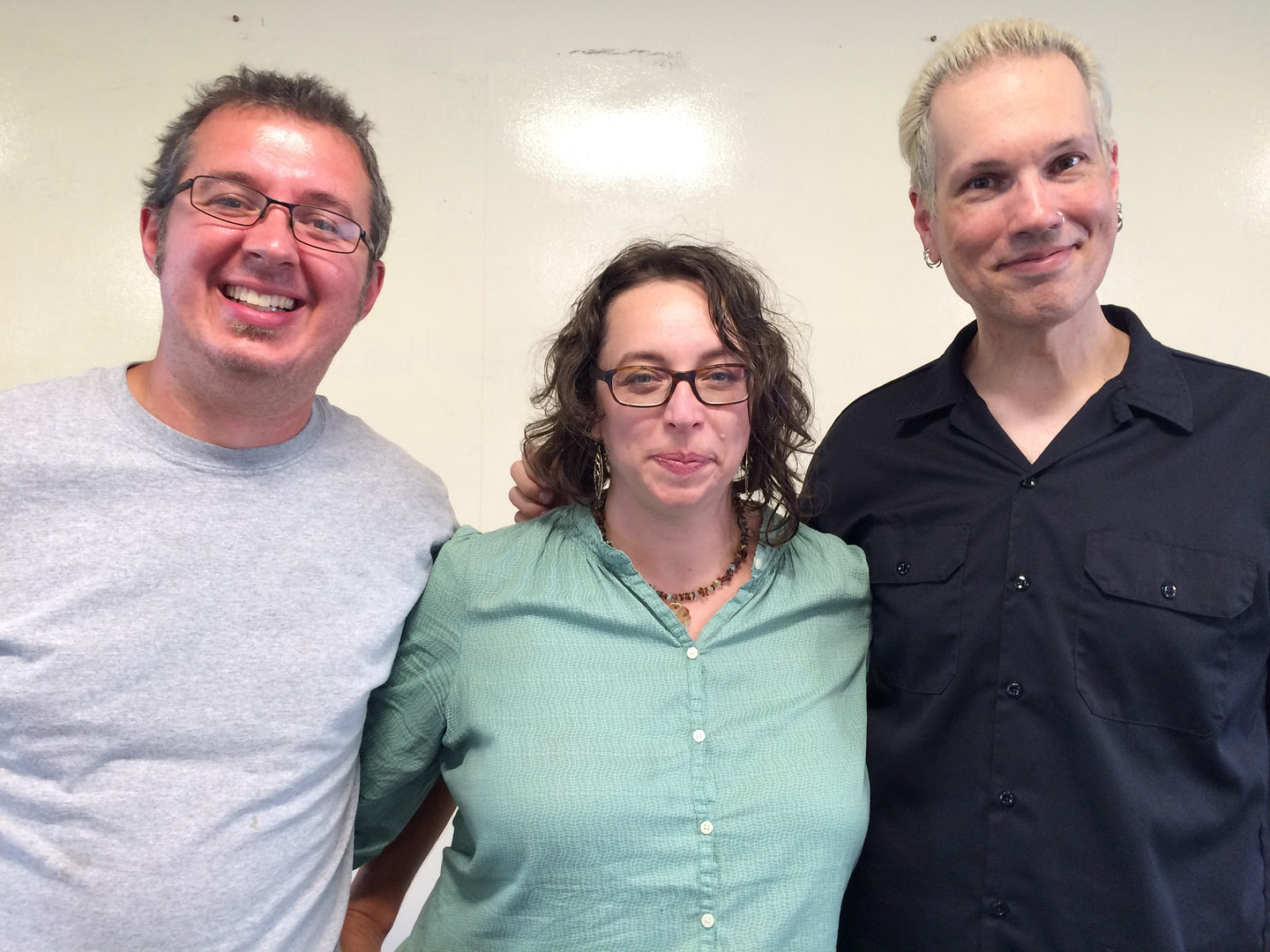
Milton, Rhonda, William
People Care

GLPDC

In 2016 I joined up with William Faith (Chicago) and Milton Dixon (Ann Arbor), to form the Great Lakes Permaculture Design Collaborative. Since that time, we’ve run a few very successful permaculture design courses, an advanced design course, various workshops, and supported our advanced design course students in developing a children’s garden and food forest in Hillside, IL. We’ve spent a lot of time weaving together permaculture people in the Chicago-area and pushing innovative approaches in our PDC.

In support of our workshops (listed on the education page), we’ve begun doing occassional videos and offering more information at our website.

If you spend time with us, you’ll see that our team is enriched by diversity of views, experiences, and approaches to permaculture. It’s a rich, inclusive, and inspiring collaboration which continues to show the healthy effects of emergent design. We hope you’ll join us!

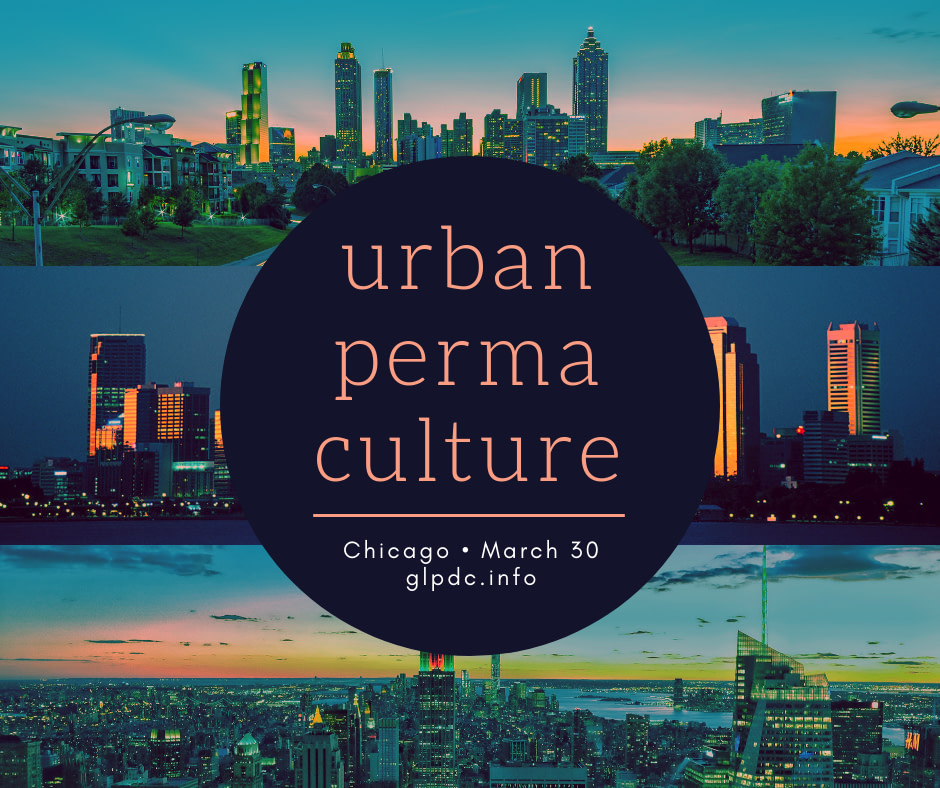
Our next workshop is on Urban Permaculture in Chicago on March 30, followed by a workshop on Social Permaculture April 27.

glpdc course announcement
Read More